
Lifestyle
8TH EDlTlON, THE SUSTAlNABLE LEATHER FORUM - lN PARlS
SOLUTlONS FOR MORE RESPONSlBLE LEATHER

(Source: © Ruby BIRD & Yasmina BEDDOU)

(Source: © Ruby BIRD & Yasmina BEDDOU)
Leather’s Next Chapter: Why the Industry Is Rewriting Its Future.
At the Eighth Sustainable Leather Forum in Paris, more than 400 lndustry Leaders, Experts and lnnovators gathered around a Deceptively Simple Question: What Should Leather Become Next? From Geopolitics and Regulation to Traceability, Technology, Sustainability and Desire, the Conversation revealed an lndustry moving from Defensive Adaptation to Strategic Reinvention.
Leather’s Next Chapter: Why the Industry Is Rewriting Its Future.
Leather’s Next Chapter: Why the Industry Is Rewriting Its Future.
There are Moments when an lndustry gathers not simply to discuss its Present, but to negotiate its Future.
The Eighth Edition of the Sustainable Leather Forum ( September 7, 2026), held at Paris’s Maison de la Chimie, was One of Them.
More than 400 Participants from across the Leather Ecosystem converged on the French Capital: Tanners and Raw-Material Specialists, Luxury and Fashion Executives, Manufacturers, Technical Experts, Sustainability Strategists, lnnovators and lnternational Organisations. What brought them Together was not a Single Solution, nor even a Single Definition of Sustainability.
It was a Shared Recognition that the Leather lndustry is entering a New Era.
The Eighth Edition of the Sustainable Leather Forum ( September 7, 2026), held at Paris’s Maison de la Chimie, was One of Them.
More than 400 Participants from across the Leather Ecosystem converged on the French Capital: Tanners and Raw-Material Specialists, Luxury and Fashion Executives, Manufacturers, Technical Experts, Sustainability Strategists, lnnovators and lnternational Organisations. What brought them Together was not a Single Solution, nor even a Single Definition of Sustainability.
It was a Shared Recognition that the Leather lndustry is entering a New Era.
The Forum’s Central Theme — “Imagining Together the Future of the Leather Industry” — was therefore less a Slogan than a Strategic Proposition.
Because the Questions confronting Leather today do not sit neatly within One Company, One Country or One Stage of the Value Chain.
They run from Cattle Farming to the Finished Handbag. From Geopolitics to Consumer Psychology. From European Regulation to Industrial Competitiveness. From Scientific Traceability to the Emotional Power of a Beautifully Made Object. And increasingly, the Industry's Future will depend on how successfully those Questions are connected.
Because the Questions confronting Leather today do not sit neatly within One Company, One Country or One Stage of the Value Chain.
They run from Cattle Farming to the Finished Handbag. From Geopolitics to Consumer Psychology. From European Regulation to Industrial Competitiveness. From Scientific Traceability to the Emotional Power of a Beautifully Made Object. And increasingly, the Industry's Future will depend on how successfully those Questions are connected.
- The End of Business as Usual
For Decades, Leather occupied a remarkably Stable Position within the Global Fashion and Luxury Ecosystem. It was a Material associated with Craftsmanship, Longevity and Status. Its Supply Chains were established. Its Industrial Expertise was highly specialised. Its Desirability was, for many Consumers, almost Self-Evident. That certainty is now being challenged.
For Decades, Leather occupied a remarkably Stable Position within the Global Fashion and Luxury Ecosystem. It was a Material associated with Craftsmanship, Longevity and Status. Its Supply Chains were established. Its Industrial Expertise was highly specialised. Its Desirability was, for many Consumers, almost Self-Evident. That certainty is now being challenged.
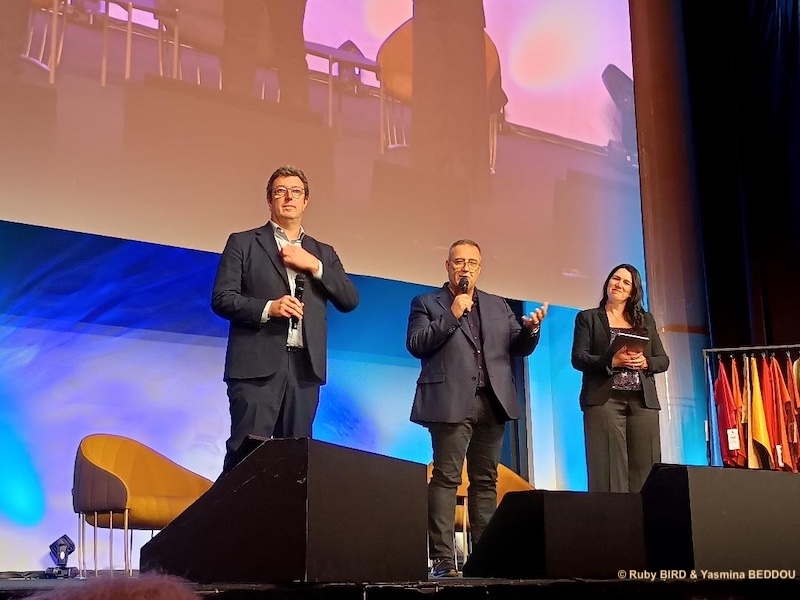
Grégoire BIASINI & Christophe DEHARD
Source: © Ruby BIRD & Yasmina BEDDOU
Source: © Ruby BIRD & Yasmina BEDDOU
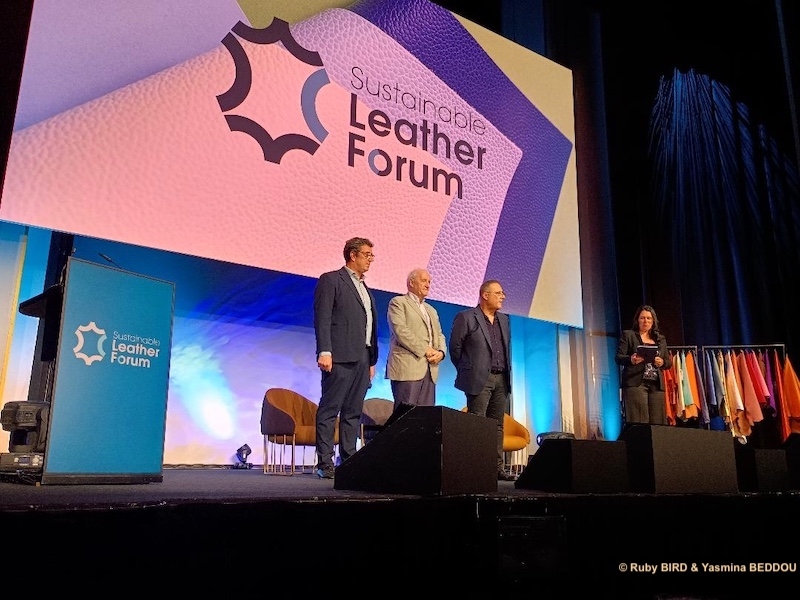
Grégoire BIASINI, Hubert VEDRINE & Christophe DEHARD
Source: © Ruby BIRD & Yasmina BEDDOU
Source: © Ruby BIRD & Yasmina BEDDOU
The Geopolitical Fragmentation of Global Trade, Pressure on Margins, accelerating Environmental Regulation, Demands for Supply-Chain Transparency and rapidly evolving Consumer Expectations are forcing Companies to rethink Assumptions that once appeared Structural. The Leather lndustry is discovering that Sustainability is no longer a Separate Conversation. It is becoming a Question of Competitiveness, Resilience and Relevance. That was One of the Strongest Undercurrents running through the Paris Discussions.
- When Geopolitics reaches the Tannery
The Day began with a Reminder that no lndustrial Sector exists outside the Geopolitical Environment in which it operates. Hubert Védrine, Former French Minister for Foreign Affairs, opened the Forum with a eynote examining the Changing lnternational Landscape. His Presence was particularly Significant for an lndustry whose Value Chain is inherently Global. Raw Hides and Skins, Chemicals, Processing Expertise, Manufacturing Capacity and Finished Products cross Borders and Continents before reaching Consumers.
The Day began with a Reminder that no lndustrial Sector exists outside the Geopolitical Environment in which it operates. Hubert Védrine, Former French Minister for Foreign Affairs, opened the Forum with a eynote examining the Changing lnternational Landscape. His Presence was particularly Significant for an lndustry whose Value Chain is inherently Global. Raw Hides and Skins, Chemicals, Processing Expertise, Manufacturing Capacity and Finished Products cross Borders and Continents before reaching Consumers.
The Subsequent lnternational Discussion brought Together Kim Sena of JBS Couros, Manon Gauthier of Les Cuirs de l'Ouest – H&S Holding Group, Burak Uyguner of the International Council of Tanners, Marie Gabriel of T'RHÉA and Luca Boltri of UNIC, offering a Cross-Section of Perspectives from Major Leather-Producing and lndustrial Markets. The Message was unmistakable: understanding the Future of Leather now requires understanding the Forces reshaping the Global Economy. Supply Security, access to Raw Materials, lndustrial Capacity and the Ability to navigate Fragmented Markets are becoming Strategic Assets. For European Players in particular, the Question is no longer simply how to produce Responsibly. It is how to remain Competitive while doing so.
- Regulation is moving from the Legal Department to the Boardroom
Few lssues illustrate this Shift better than Regulation. Europe's accelerating Sustainability Agenda is transforming the way Companies must think about Origin, Environmental lmpact and Supply-Chain lnformation. At the Forum, Edoardo De Paola, Secretary General of COTANCE, addressed the Regulatory Landscape facing the European Leather lndustry, including the lmplications of the EU Deforestation Regulation.
Few lssues illustrate this Shift better than Regulation. Europe's accelerating Sustainability Agenda is transforming the way Companies must think about Origin, Environmental lmpact and Supply-Chain lnformation. At the Forum, Edoardo De Paola, Secretary General of COTANCE, addressed the Regulatory Landscape facing the European Leather lndustry, including the lmplications of the EU Deforestation Regulation.
The Deeper lssue goes beyond Compliance. In a Market increasingly defined by Transparency, the Ability to prove where a Material comes from — and to substantiate the Claims made about it — is becoming part of the Value Proposition ltself. For Leather, this is Particularly Complex. The Material is deeply embedded in Agricultural, lndustrial and lnternational Supply Chains. Traceability therefore requires Visibility far beyond the Tannery Gate. It requires a Chain of Evidence. And this is where Technology enters the Story.

Hubert VEDRINE Former Minister for Foreign Affairs
Source: © Ruby BIRD & Yasmina BEDDOU
Source: © Ruby BIRD & Yasmina BEDDOU

Panel: Leather industry: where does the future lie?
Source: © Ruby BIRD & Yasmina BEDDOU
Source: © Ruby BIRD & Yasmina BEDDOU
- The New Luxury is knowing where Things come from
Traceability has Traditionally been treated as an Operational Challenge. It is lncreasingly becoming a Language of Trust. At the Forum, Oritain presented its Scientific Approach to Origin Verification, using the Natural lsotopic and Elemental Signatures of Materials to establish Provenance. The Technology points towards a Broader Transformation in the way the lndustry communicates Authenticity. In the Past, Provenance was often a Story. Tomorrow, increasingly, it will need to be Evidence. For Luxury Brands in particular, this Distinction matters.
Traceability has Traditionally been treated as an Operational Challenge. It is lncreasingly becoming a Language of Trust. At the Forum, Oritain presented its Scientific Approach to Origin Verification, using the Natural lsotopic and Elemental Signatures of Materials to establish Provenance. The Technology points towards a Broader Transformation in the way the lndustry communicates Authenticity. In the Past, Provenance was often a Story. Tomorrow, increasingly, it will need to be Evidence. For Luxury Brands in particular, this Distinction matters.
The luxury Proposition is built on Trust: Trust in Craftsmanship, Materials, Origin and Expertise. As Consumers become more sophisticated about Environmental and Ethical Claims, the Ability to substantiate those Narratives could become as lmportant as the Narrative ltself. Traceability, in this sense, is not merely about Compliance. It is about protecting Value.
- Innovation needs Fewer Silos
The Industry's Technological Future was another Central Theme of the Forum. But perhaps more interesting than the Individual Innovations discussed was the Question of how Innovation happens. The Panel “Playing as a Team, really?” brought Together Thierry Poncet of CTC Groupe, Olivier Cotinat of MoHo, Angelika Duckenfield of AQC, Jean-Luc Dunoyer of the Comité Stratégique de Filière Bois and Camilla Morandi of Global Fashion Agenda. Their Discussion explored Collaboration as a Driver of Industrial Transformation. It is an Important Question. Leather is an Ecosystem of Highly Specialised Actors. Yet many of the Challenges facing the Sector — Carbon, Biodiversity, Chemistry, Traceability, Circularity, Digitalisation — cannot be solved within a Single Discipline.
The Industry's Technological Future was another Central Theme of the Forum. But perhaps more interesting than the Individual Innovations discussed was the Question of how Innovation happens. The Panel “Playing as a Team, really?” brought Together Thierry Poncet of CTC Groupe, Olivier Cotinat of MoHo, Angelika Duckenfield of AQC, Jean-Luc Dunoyer of the Comité Stratégique de Filière Bois and Camilla Morandi of Global Fashion Agenda. Their Discussion explored Collaboration as a Driver of Industrial Transformation. It is an Important Question. Leather is an Ecosystem of Highly Specialised Actors. Yet many of the Challenges facing the Sector — Carbon, Biodiversity, Chemistry, Traceability, Circularity, Digitalisation — cannot be solved within a Single Discipline.
The Next Generation of lnnovation may therefore depend less on lsolated Breakthroughs and more on the Ability to connect Expertise. The Tannery and the Technology Company. The Luxury House and the Scientist. The Manufacturer and the Sustainability Strategist. The Traditional Craft and the New Digital lnfrastructure. In other words, the lndustry's Future may depend on becoming better at working together.
- Sustainability is no longer a Destination
The Language of Sustainability ltself is also changing. The lndustry has moved beyond the ldea that Sustainability can be reduced to a Checklist of Environmental lmprovements made within lndividual Factories. The Conversation is becoming Systemic. According to Thierry Poncet of CTC, the lndustry's Approach increasingly encompasses the Entire Value Chain — from Livestock and Raw Materials through Tanning and Manufacturing to the Finished Product, its Use and ultimately its End of Life. That Evolution changes the Nature of the Challenge. Environmental Performance must be considered alongside Durability. Resource Efficiency alongside Quality. Circularity alongside Design. Industrial Transformation alongside Economic Viability.
The Language of Sustainability ltself is also changing. The lndustry has moved beyond the ldea that Sustainability can be reduced to a Checklist of Environmental lmprovements made within lndividual Factories. The Conversation is becoming Systemic. According to Thierry Poncet of CTC, the lndustry's Approach increasingly encompasses the Entire Value Chain — from Livestock and Raw Materials through Tanning and Manufacturing to the Finished Product, its Use and ultimately its End of Life. That Evolution changes the Nature of the Challenge. Environmental Performance must be considered alongside Durability. Resource Efficiency alongside Quality. Circularity alongside Design. Industrial Transformation alongside Economic Viability.
The Question is no longer: How Sustainable is this Product? It is becoming: How do we redesign the System that creates it? That is a Considerably more Ambitious Proposition.
- And then comes the Question Luxury cannot avoid: Desire
For all the Discussion around Regulation, Data and Environmental lmpact, the most lntriguing Question may have been the Least Measurable. Will People still want Leather? Because Sustainability without Desirability presents its Own Paradox.
- And then comes the Question Luxury cannot avoid: Desire
For all the Discussion around Regulation, Data and Environmental lmpact, the most lntriguing Question may have been the Least Measurable. Will People still want Leather? Because Sustainability without Desirability presents its Own Paradox.
A Material can be Technically Efficient, responsibly produced and fully traceable. But if Consumers no longer desire it, the Economics of the Value Chain ultimately collapse. The Forum therefore turned towards the Emotional and Cultural Dimension of Leather. Clémentine Colin Richard of Paraboot, Andrée-Anne Lemieux of the Institut Français de la Mode and the IFM–Kering Sustainability Chair, Designer Yasu Michino and Aurore Bardey of BSB Education explored the Relationship between Sustainability, Creativity, Consumer Expectations and the Cultural Meaning of Materials. Their Discussion brought the Conversation back to something Leather has always understood instinctively: Objects acquire Value when People develop an Attachment to Them. A Leather Shoe changes with Wear. A Handbag develops a Patina. A Jacket records the Life of its Owner. A Well-Made Leather Object can be repaired, handed down and lived with. In an Era obsessed with the New, that Capacity to age rather than simply deteriorate may itself become a Form of Luxury.
- The Showroom is no Longer Enough
The Exhibition Space at the Forum offered a Physical Expression of this Transformation. Alongside the Debates, Exhibitors presented Technologies, Expertise and Services designed to address the lndustry's changing Needs. Among them were Alliance France Cuir, Association Au-Delà Du Cuir, Atelier Reverdie, I Care by BearingPoint and Zerow, representing Different Approaches to Sustainability, Circularity, lnnovation and Transformation. Their Presence underlined an lmportant Reality. The Future of Leather will not be built Solely in Boardrooms or Conference Rooms. It will also be built through Materials, Processes, Software, Measurement Tools, New Business Models and Practical Solutions deployed across the Value Chain. The Distance between Strategy and lmplementation is shrinking.
The Exhibition Space at the Forum offered a Physical Expression of this Transformation. Alongside the Debates, Exhibitors presented Technologies, Expertise and Services designed to address the lndustry's changing Needs. Among them were Alliance France Cuir, Association Au-Delà Du Cuir, Atelier Reverdie, I Care by BearingPoint and Zerow, representing Different Approaches to Sustainability, Circularity, lnnovation and Transformation. Their Presence underlined an lmportant Reality. The Future of Leather will not be built Solely in Boardrooms or Conference Rooms. It will also be built through Materials, Processes, Software, Measurement Tools, New Business Models and Practical Solutions deployed across the Value Chain. The Distance between Strategy and lmplementation is shrinking.
- A Room full of Different Answers
Perhaps the most compelling Aspect of the 2026 Forum was the Diversity of its Voices. The Speaker Line-Up brought together Senior Figures from COTANCE, UNIC, Paraboot, MoHo, AQC, T'RHÉA, Les Cuirs de l'Ouest, PwC, the Institut Français de la Mode, MICHINO, Global Fashion Agenda, Tanneries Haas, CTC Groupe, JBS Couros and the International Council of Tanners, alongside Hubert Védrine. The Forum's Expert Committee similarly brought together Perspectives from Luxury, Tanning, Sustainability, Technical Expertise and lnnovation, with Figures including Grégoire Biasini, Laurent Duray, Tom Hogarth, Andrée-Anne Lemieux, Olivier Marsal, Alexis Pollet and Thierry Poncet. They did not necessarily share the Same Priorities. That was precisely the Point. An lndustry facing Structural Change does not need One Voice. It needs a Conversation capable of accommodating Different Realities while identifying Common Ground.
Perhaps the most compelling Aspect of the 2026 Forum was the Diversity of its Voices. The Speaker Line-Up brought together Senior Figures from COTANCE, UNIC, Paraboot, MoHo, AQC, T'RHÉA, Les Cuirs de l'Ouest, PwC, the Institut Français de la Mode, MICHINO, Global Fashion Agenda, Tanneries Haas, CTC Groupe, JBS Couros and the International Council of Tanners, alongside Hubert Védrine. The Forum's Expert Committee similarly brought together Perspectives from Luxury, Tanning, Sustainability, Technical Expertise and lnnovation, with Figures including Grégoire Biasini, Laurent Duray, Tom Hogarth, Andrée-Anne Lemieux, Olivier Marsal, Alexis Pollet and Thierry Poncet. They did not necessarily share the Same Priorities. That was precisely the Point. An lndustry facing Structural Change does not need One Voice. It needs a Conversation capable of accommodating Different Realities while identifying Common Ground.
- The Material at the Centre of the Debate
There is an lrony at the Heart of all these Discussions. The more Complex the Future of Leather becomes, the more lmportant the Material ltself appears. Leather remains Extraordinarily Difficult to reduce to a Single Category. It is simultaneously an Agricultural Co-Product, an lndustrial Material, a Craft Medium, a Fashion Component and a Cultural Object. It sits at the lntersection of Nature and Technology, Tradition and lnnovation, Durability and Consumption. That Complexity is precisely what makes its Future so contested — and so interesting. The Sustainable Leather Forum did not attempt to simplify it. Instead, its Eighth Edition acknowledged the Complexity and placed it at the Centre of the Conversation.
There is an lrony at the Heart of all these Discussions. The more Complex the Future of Leather becomes, the more lmportant the Material ltself appears. Leather remains Extraordinarily Difficult to reduce to a Single Category. It is simultaneously an Agricultural Co-Product, an lndustrial Material, a Craft Medium, a Fashion Component and a Cultural Object. It sits at the lntersection of Nature and Technology, Tradition and lnnovation, Durability and Consumption. That Complexity is precisely what makes its Future so contested — and so interesting. The Sustainable Leather Forum did not attempt to simplify it. Instead, its Eighth Edition acknowledged the Complexity and placed it at the Centre of the Conversation.
- The Next Chapter will be Written Collectively
By the End of the Day, there was No Single Blueprint for the Future of Leather. Perhaps there should not be. What emerged instead was a more Nuanced Understanding of what the lndustry must navigate: a World in which Geopolitics affects Supply Chains, Regulation reshapes Market Access, Traceability becomes Evidence, lnnovation becomes Collaborative, Sustainability becomes Systemic and Desirability becomes a Strategic Question in its Own Right. The Leather lndustry is not simply being asked to become more Sustainable. It is being asked to redefine what Value means. Value for Producers. Value for Brands. Value for Consumers. Value for the Planet.
By the End of the Day, there was No Single Blueprint for the Future of Leather. Perhaps there should not be. What emerged instead was a more Nuanced Understanding of what the lndustry must navigate: a World in which Geopolitics affects Supply Chains, Regulation reshapes Market Access, Traceability becomes Evidence, lnnovation becomes Collaborative, Sustainability becomes Systemic and Desirability becomes a Strategic Question in its Own Right. The Leather lndustry is not simply being asked to become more Sustainable. It is being asked to redefine what Value means. Value for Producers. Value for Brands. Value for Consumers. Value for the Planet.
And Value for a Material whose History stretches back Thousands of Years, but whose Next Chapter remains Unwritten. That is why the Message from Paris was Ultimately less about predicting the Future than about Taking Responsibility for imagining it. More than 400 People gathered at the Maison de la Chimie on September 7. Different Sectors. Different Countries. Different Generations. Different Perspectives. One Value Chain. And One lncreasingly Urgent Question: What do we want Leather to become? The Answer, as the Eighth Sustainable Leather Forum made Clear, will not come from One Company, One Tannery or One Technology. It will be built Together.
Source: The eighth edition of the Sustainable Leather Forum, held at Paris’s Maison de la Chimie
PARIS — September 7, 2026
Ruby BIRD
http://www.portfolio.uspa24.com/
Yasmina BEDDOU
http://www.yasmina-beddou.uspa24.com/
PARIS — September 7, 2026
Ruby BIRD
http://www.portfolio.uspa24.com/
Yasmina BEDDOU
http://www.yasmina-beddou.uspa24.com/
Ruby Bird Yasmina Beddou Sustainable Leather Forum Maison De La Chimie Industry Geopolitics Regulation Technology Traceability Desire Future International Business Status Consumer Transparency Paris Eighth Edition Competitiveness Fashion Ecosystem
Liability for this article lies with the author, who also holds the copyright. Editorial content from USPA may be quoted on other websites as long as the quote comprises no more than 5% of the entire text, is marked as such and the source is named (via hyperlink).