
Politics
FRENCH POLITICS ENTERS THE IRAN CRISIS: GOVERNMENT LINE Vs OPPOSITION PRESSURE
RN's J. BARDELLA CALLS FOR CLARITY
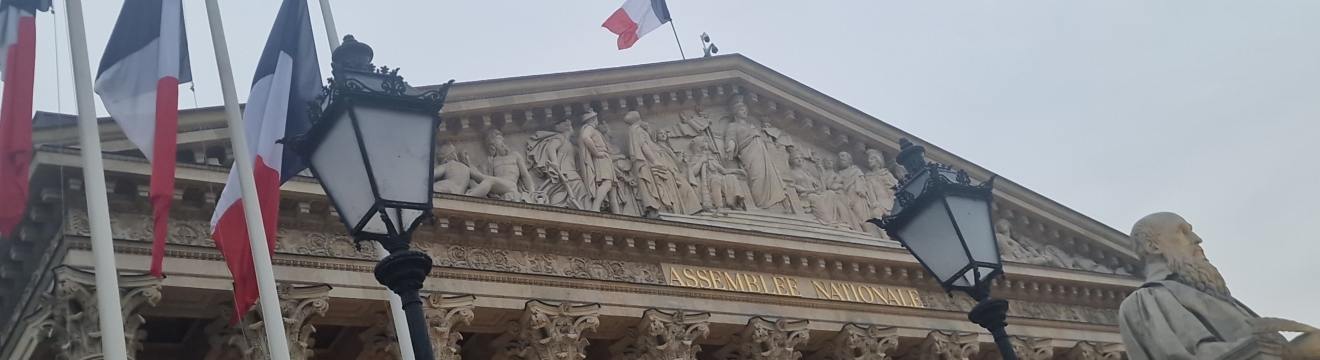
French National Assembly (Source: Rahma Sophia Rachdi, Jedi Foster)
USPA NEWS -
As missiles and drones continue to fly between Iran, Israel and US linked bases in the Gulf, the Iran crisis has now fully entered the French domestic political arena. While President Emmanuel Macron convenes his second Defence and National Security Council in forty eight hours, government spokespeople and opposition leaders are trying to frame what this confrontation means for France’s security, diplomacy and energy supplies. Beyond the immediate military developments, the debate over Iran is fast becoming a test of trust in the executive and a dress rehearsal for the intense electoral calendar that lies ahead. This is an editorial, not on the ground reporting. It reflects the independent analysis of our handy journalist and relies on officially available French information and verified public statements.
As missiles and drones continue to fly between Iran, Israel and US linked bases in the Gulf, the Iran crisis has now fully entered the French domestic political arena. While President Emmanuel Macron convenes his second Defence and National Security Council in forty eight hours, government spokespeople and opposition leaders are trying to frame what this confrontation means for France’s security, diplomacy and energy supplies. Beyond the immediate military developments, the debate over Iran is fast becoming a test of trust in the executive and a dress rehearsal for the intense electoral calendar that lies ahead. This is an editorial, not on the ground reporting. It reflects the independent analysis of our handy journalist and relies on officially available French information and verified public statements.
THE GOVERNMENT’S MESSAGE: CONDEMNATION OF KHAMENEI, DISTANCE FROM THE STRIKES
On the government side, the line seeks to be both firm and nuanced. After confirmation of Ali Khamenei’s death in the joint US Israeli operation, government spokeswoman Maud Bregeon described the late Supreme Leader as “a blood stained dictator who oppressed his people” and said that France could “only be satisfied” with the end of his rule. The choice of words is unusually blunt for a French official about a foreign head of state, even a theocratic one, and reflects years of frustration in Paris over the repression of Iranian protesters, the persecution of women and minorities, and Iran’s regional destabilisation.
On the government side, the line seeks to be both firm and nuanced. After confirmation of Ali Khamenei’s death in the joint US Israeli operation, government spokeswoman Maud Bregeon described the late Supreme Leader as “a blood stained dictator who oppressed his people” and said that France could “only be satisfied” with the end of his rule. The choice of words is unusually blunt for a French official about a foreign head of state, even a theocratic one, and reflects years of frustration in Paris over the repression of Iranian protesters, the persecution of women and minorities, and Iran’s regional destabilisation.
At the same time, the Elysee has gone out of its way to stress that France was “neither informed nor involved” in the initial strikes carried out by the United States and Israel, and that its priority remains the security of French nationals, the protection of its military and diplomatic facilities, and the stability of its own territory. In his first Defence Council, Emmanuel Macron insisted that “no one can think that the question of Iran’s nuclear programme, its ballistic activities and regional destabilisation will be resolved simply by airstrikes,” and he called for an urgent meeting of the UN Security Council. The message is clear: Paris condemns Khamenei’s record and supports the right of Iranians to decide their own future, but it does not want to be dragged into an open ended war logic designed elsewhere.
This balancing act is not without risk. For part of the French public, strong words against a “dictator” can sound like a prelude to deeper involvement alongside Washington and Jerusalem. For others, insisting on diplomacy and distance may look like weakness in the face of a regime that has targeted European interests for years. Managing these perceptions will be one of the challenges for the Elysée in the coming days as the military situation evolves.
JORDAN BARDELLA’S DEMAND FOR CLARITY AND PARLIAMENTARY CONSULTATION
On the opposition benches, the far right Rassemblement national has moved quickly to occupy the political space opened by the crisis. Its president, Jordan Bardella, has called on Emmanuel Macron to “bring together the leaders of the parties represented in Parliament” in order to provide a “full briefing” on the security, geopolitical, economic and energy implications of the Iran confrontation. In a statement posted on X, he urges the head of state to “clarify the role of our country in this period of uncertainty,” implicitly suggesting that the executive might be hiding the true extent of France’s involvement or exposure.
On the opposition benches, the far right Rassemblement national has moved quickly to occupy the political space opened by the crisis. Its president, Jordan Bardella, has called on Emmanuel Macron to “bring together the leaders of the parties represented in Parliament” in order to provide a “full briefing” on the security, geopolitical, economic and energy implications of the Iran confrontation. In a statement posted on X, he urges the head of state to “clarify the role of our country in this period of uncertainty,” implicitly suggesting that the executive might be hiding the true extent of France’s involvement or exposure.
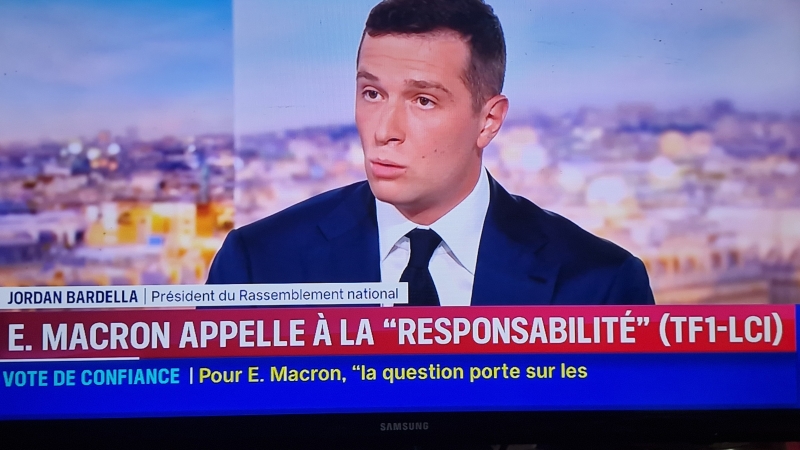
Jordan Bardella VP, RN
Source: LCP TV Caption
Source: LCP TV Caption
Jordan Bardella, National rally (RN, Le Pen’s Party, Far Right Patry) goes further by linking the external crisis to the question of regime change in Tehran. After the announcement of Khamenei’s death, he argued that “even if regime change were made possible by these external strikes, it could only be legitimate and durable if it comes from an uprising of the Iranian people themselves.” This formulation allows him to position himself as both a defender of national sovereignty and someone who recognises the aspirations of Iranian citizens, without endorsing the strategy chosen by Washington and Jerusalem. It also echoes broader far right criticisms of what they see as President Macron’s tendency to follow US priorities on Ukraine, NATO and now Iran.
For the Elysee, this type of pressure raises a familiar dilemma: how much information to share on an ongoing, highly sensitive crisis without fuelling panic or partisan exploitation. France is not formally at war, but it has forces stationed in several countries that are already under Iranian fire, and it is part of the Western coalition that has long tried to contain Tehran’s nuclear and regional ambitions. In such conditions, calls for a cross party briefing will be difficult to ignore, especially if the conflict drags on and if French soldiers or citizens are injured.
A CRISIS THAT WILL RESONATE IN THE 2026–2027 ELECTORAL CYCLE
Beyond immediate statements from ministers and opposition leaders, the Iran crisis is likely to leave a deeper mark on France’s political landscape. For the governing camp, it is another reminder that domestic debates on purchasing power, immigration or pensions can at any moment be overshadowed by geopolitical shocks, from Russia’s war in Ukraine to the current confrontation with Iran. For the opposition, it offers an opportunity to question the coherence of President Macron’s foreign policy and to argue that France should either stand closer to its allies or, on the contrary, pursue a more independent line.
Beyond immediate statements from ministers and opposition leaders, the Iran crisis is likely to leave a deeper mark on France’s political landscape. For the governing camp, it is another reminder that domestic debates on purchasing power, immigration or pensions can at any moment be overshadowed by geopolitical shocks, from Russia’s war in Ukraine to the current confrontation with Iran. For the opposition, it offers an opportunity to question the coherence of President Macron’s foreign policy and to argue that France should either stand closer to its allies or, on the contrary, pursue a more independent line.
As the strikes continue, as Trump talks openly about a multi week operation and as Tehran promises unprecedented retaliation, French voters may begin to ask more pointed questions: What are our bases in the Gulf really doing? How exposed are our troops and nationals? Could France be targeted on its own territory by cyberattacks, terrorism or disinformation campaigns linked to the conflict? And, more broadly, what is the price, in energy, in security, in political cohesion, of being a medium sized power trying to navigate between Washington, Moscow, Beijing and now Tehran?
In the weeks ahead, we will keep following not only the military developments in the Middle East but also the way this crisis reshapes the conversation in Paris, at the National Assembly and on the campaign trail (Ongoing Municipal Elections) . Whether they sit in government or in opposition, French leaders will have to explain to citizens how far they are ready to go in supporting allies, protecting national interests and defending the rights of the Iranian people , and where, in this emerging war between Israel, Iran and the United States, they believe France’s red lines truly lie.To Be Continued...
Liability for this article lies with the author, who also holds the copyright. Editorial content from USPA may be quoted on other websites as long as the quote comprises no more than 5% of the entire text, is marked as such and the source is named (via hyperlink).