Politics
FRENCH PM SEBASTIEN LECORNU INVITED TO ATTEND HIGH LEVEL MEETING IN MOROCCO
STRONG DELEGATION OF 12 MINISTERS
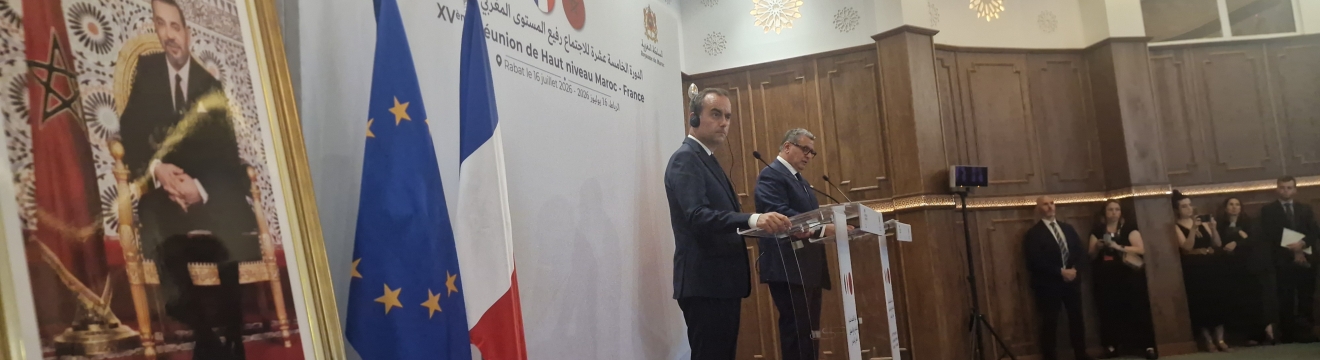
French PM S.Lecornu/Moroccan PM A. Akhannouche RHN (Source: Rahma Sophia Rachdi, Jedi Foster)
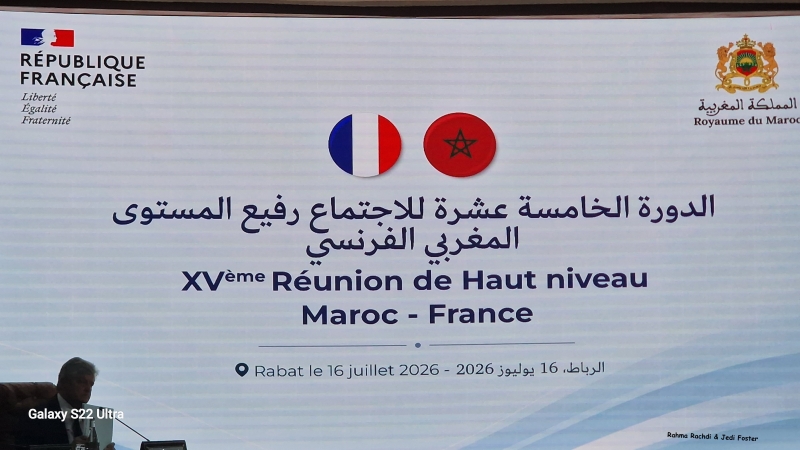
French PM S.Lecornu/Moroccan PM A. Akhannouche RHN
(Source: Rahma Sophia rachdi Jedi Foster)
(Source: Rahma Sophia rachdi Jedi Foster)
Between these two electoral horizons, the RHN (HLM, High Level Meeting) functions as a hinge: a moment where both executives seek to stabilise a “Reinforced Exceptional Partnership” before their domestic politics potentially shift. It is in this interstice that the Rabat meeting takes place, under the gaze of the monarchy in Morocco and under the pressure of future ballot boxes in France.
RABAT- SALE ‘ AIRPORT ARRIVAL CEREMONY OF FRENCH DELEGATION & FIRST SCENES
The story begins on the night of 15 July, after 10:30 pm, on the tarmac of Rabat–Sale airport, the administrative capital of the Kingdom and seat of the Royal Palace where the royal family resides. Under the floodlights, the French government jet taxis to a halt, its door opening onto a compact delegation led by Prime Minister Lecornu and twelve ministers, received by Moroccan officials, protocol officers and security services.
On the tarmac, a tight group of French and Moroccan journalists, flanked by bodyguards and police, waits behind a cordon; among them, one disabled binational reporter in a wheelchair, the only journalist holding both passports, watching from ground level as hands are shaken, flags are aligned and the choreography of a “reset” relationship is played out in real time. The scene is both highly scripted and quietly human: a brief exchange, a gesture of support on a ramp, a word of welcome from a protocol officer who insists that accessibility is part of the hospitality offered to the visiting delegation and to its media.
The story begins on the night of 15 July, after 10:30 pm, on the tarmac of Rabat–Sale airport, the administrative capital of the Kingdom and seat of the Royal Palace where the royal family resides. Under the floodlights, the French government jet taxis to a halt, its door opening onto a compact delegation led by Prime Minister Lecornu and twelve ministers, received by Moroccan officials, protocol officers and security services.
On the tarmac, a tight group of French and Moroccan journalists, flanked by bodyguards and police, waits behind a cordon; among them, one disabled binational reporter in a wheelchair, the only journalist holding both passports, watching from ground level as hands are shaken, flags are aligned and the choreography of a “reset” relationship is played out in real time. The scene is both highly scripted and quietly human: a brief exchange, a gesture of support on a ramp, a word of welcome from a protocol officer who insists that accessibility is part of the hospitality offered to the visiting delegation and to its media.
TARMAC FRESH NIGHT FOR PRIME MINISTER LECORNU’s ARRIVAL CEREMONY UNDER ARABIC STARRED SKY
The story truly begins on the night of 15 July, on the tarmac of Rabat–Sale airport, under a starred sky and in an air so fresh it feels worlds away from the suffocating Paris heatwave left behind only a few hours earlier. Floodlights cut through the darkness as the French government jet rolls to a halt, its white fuselage catching the light before the door opens onto Prime Minister Sebastien Lecornu and the ministers who have crossed the Mediterranean with him. In that first suspended moment, before the statements, before the signatures, before the communiqué, diplomacy takes the form of bodies in motion, uniforms, light, breath and music.
The story truly begins on the night of 15 July, on the tarmac of Rabat–Sale airport, under a starred sky and in an air so fresh it feels worlds away from the suffocating Paris heatwave left behind only a few hours earlier. Floodlights cut through the darkness as the French government jet rolls to a halt, its white fuselage catching the light before the door opens onto Prime Minister Sebastien Lecornu and the ministers who have crossed the Mediterranean with him. In that first suspended moment, before the statements, before the signatures, before the communiqué, diplomacy takes the form of bodies in motion, uniforms, light, breath and music.
Awaiting the delegation on the Moroccan side are Foreign Minister Nasser Bourita, senior officials, protocol teams, security officers and the royal military honours detachment, all positioned with the exactness that high?level state receptions demand. As Lecornu steps forward, he is greeted by Bourita before both men proceed together to review the guard, passing in slow, measured cadence before the ranks of the Republican Guard and the royal ceremonial formation. A military march, short and solemn, rises into the night, carried by the musicians of the Royal Guard with that unmistakable mixture of discipline and pageantry that turns a protocol sequence into something almost theatrical.
Then comes the second line of the tableau: the row of French ministers, a dozen in all, aligned one after another, each waiting for the formal greetings that place them, symbolically, inside the architecture of the visit. Behind and around them, bodyguards, police officers, embassy personnel, Moroccan foreign?ministry staff and a tight knot of French and Moroccan journalists hold their positions, watching, filming, noting details, reading gestures. The atmosphere is at once military and diplomatic, ceremonial and strangely intimate a reception of state, yes, but one unfolding under the open sky, in that luminous Rabat night where even protocol seems to breathe more slowly.
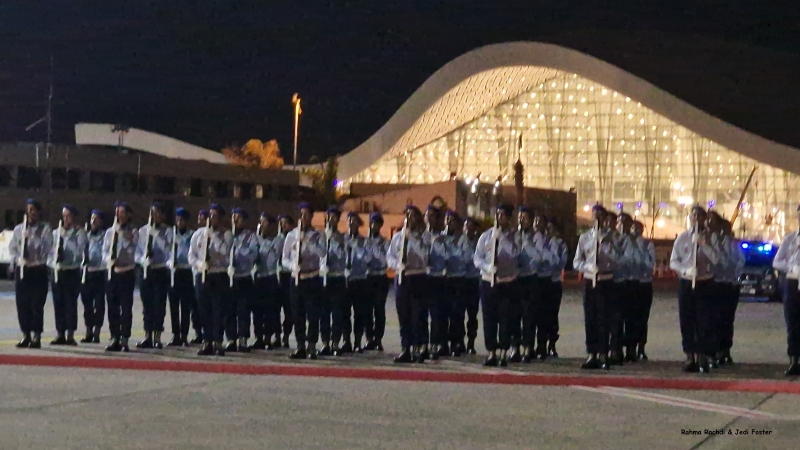
French PM S.Lecornu/Moroccan PM A. Akhannouche RHN, Rabat
Source: Rahma Sophia Rachdi, Jedi Foster
Source: Rahma Sophia Rachdi, Jedi Foster
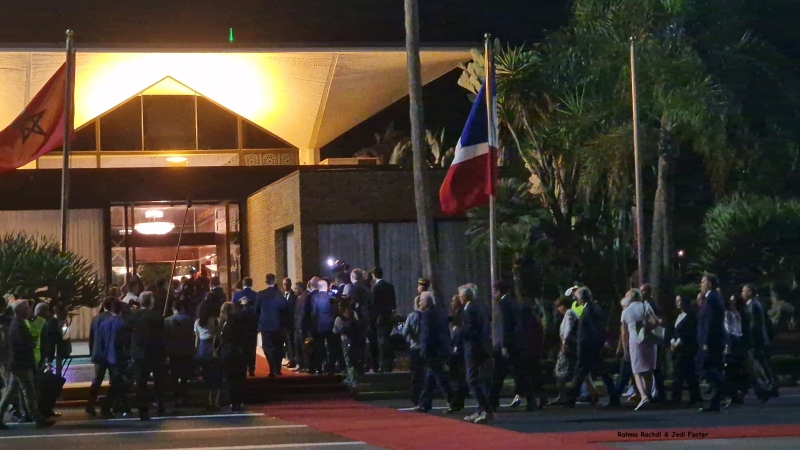
French PM S.Lecornu/Arrival Tarmac Airport, Rabat
Source: Rahma Sophia Rachdi, Jedi Foster
Source: Rahma Sophia Rachdi, Jedi Foster
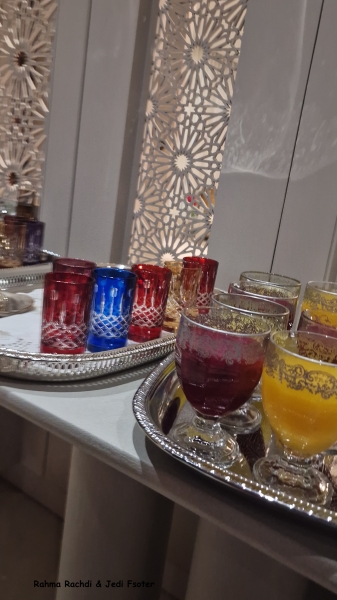
Moroccan Hospitality VIP Lounge Airport Rabat
Source: Rahma Sophia Rachdi, Jedi Foster
Source: Rahma Sophia Rachdi, Jedi Foster
From ground level, the binational reporter in a wheelchair watches the scene with the sharpened attention that only field reporting produces: the small delay before a salute, the metallic glint of insignia, the friction of shoes on the tarmac, the way the line of ministers appears almost sculptural under the runway lights. What unfolds is not merely the arrival of a French prime minister on his first trip abroad. It is the opening image of a sequence already loaded with history between two old friends and allies, long connected by a shared past, now trying to give that past a new diplomatic language.
FOOTBALL AND MOROCCAN ART OF RECEIVING
It is in the VIP lounge of Rabat–Sale airport that the high?level choreography briefly relaxes into something more intimate, without ever losing its sense of occasion. By late evening, the security cordon that had framed the arrival of Prime Minister Lecornu and his twelve ministers has shifted indoors: bodyguards in dark suits, border police in uniform, embassy staff, Moroccan foreign?affairs officials and a compact pool of journalists mingle under the soft light of chandeliers. The air smells of mint and freshly baked pastries; trays of steaming mint tea and plates of most famous Moroccan almond cakes “Cornes de gazelle” circulate between armchairs and refined decorated handcrafted low tables.
This is hospitality at high profile and on a human scale: a lounge refined to the last detail, with large flat?screen televisions framed by zellige patterns and carved wood, cushions chosen with the same care as the diplomatic words that will be spoken the next day. On the screens, a World Cup?style semi?final between Argentina and England unfolds, ending 2–1 in favour of Argentina. The match is followed collectively, almost liturgically: guards, police officers, journalists, embassy staff and Moroccan officials all look up at once when a goal is scored, then return to their conversations about visas, security cooperation or the next sequence on the Prime Minister’s agenda.
From a wheelchair placed near the glass wall that overlooks the runway, the binational reporter takes in the scene as a condensed version of Moroccan art de vivre: the way tea is poured and served kindly by a lovely Moroccan hostess high into slender glasses, the way “cornes de gazelle” are offered before being asked for; the way staff discreetly adjust seating so that everyone, Ministers and journalists, the sole disabled guest included can see the match and the runway. The legendary hospitality of Moroccans is not an abstract cliché here; it is a series of small gestures and permanent smiling that make this high?level lounge feel like a salon, where diplomacy, football and everyday life briefly share the same table.
RABAT AND CASABLANCA: TWO CAPITALS, ONE AXIS
Rabat, from which this report is filed, is Morocco’s administrative capital: a city where ministries, embassies and the Royal Palace cluster along the Atlantic, and where state rituals, from Throne Day speeches to foreign visits, are staged. Casablanca, by contrast, is the country’s economic capital: a sprawling metropolis of finance, industry and trade, home to the main stock exchange and a dense urban population.
Together, they anchor a kingdom of around 37 million inhabitants, with metropolitan Rabat hosting over 1.5 million people in its wider urban area. In this geography, the Rabat–Casablanca axis concentrates both political and economic power, and it is here that France seeks to reposition itself: as a partner in infrastructure, energy and industry, but also as a political actor that must now deal with a confident, sovereign monarchy whose influence stretches deep into Africa.
Rabat, from which this report is filed, is Morocco’s administrative capital: a city where ministries, embassies and the Royal Palace cluster along the Atlantic, and where state rituals, from Throne Day speeches to foreign visits, are staged. Casablanca, by contrast, is the country’s economic capital: a sprawling metropolis of finance, industry and trade, home to the main stock exchange and a dense urban population.
Together, they anchor a kingdom of around 37 million inhabitants, with metropolitan Rabat hosting over 1.5 million people in its wider urban area. In this geography, the Rabat–Casablanca axis concentrates both political and economic power, and it is here that France seeks to reposition itself: as a partner in infrastructure, energy and industry, but also as a political actor that must now deal with a confident, sovereign monarchy whose influence stretches deep into Africa.
ROYAL LINEAGE AND BILATERAL MEMORY FOR AN ANCESTRAL CHERIFIAN EMPIRE
The reset of the France–Morocco relationship is framed not only by technical agreements, but by a royal lineage that runs from Mohammed V to Mohammed VI and by a historical entity long known as the Cherifian Empire. Mohammed V, the “King of Independence”, steered the country from protectorate to sovereignty in 1956 and chose reconciliation where others chose rupture, allowing some French citizens to remain and maintaining a thread of political and human continuity between Rabat and Paris.
His son Hassan II, a shrewd francophone strategist, transformed that legacy into institutions and diplomatic architecture, using mechanisms like the High?Level Meeting to formalize what had once been informal “special relations”. Under his reign, the notion of the Cherifian Empire a multi?ethnic, multi?confessional entity led by a dynasty claiming descent from the Prophet Mohammed PBUH was translated into a modern monarchy that could negotiate with Paris on more equal, if still asymmetrical, terms.
The reset of the France–Morocco relationship is framed not only by technical agreements, but by a royal lineage that runs from Mohammed V to Mohammed VI and by a historical entity long known as the Cherifian Empire. Mohammed V, the “King of Independence”, steered the country from protectorate to sovereignty in 1956 and chose reconciliation where others chose rupture, allowing some French citizens to remain and maintaining a thread of political and human continuity between Rabat and Paris.
His son Hassan II, a shrewd francophone strategist, transformed that legacy into institutions and diplomatic architecture, using mechanisms like the High?Level Meeting to formalize what had once been informal “special relations”. Under his reign, the notion of the Cherifian Empire a multi?ethnic, multi?confessional entity led by a dynasty claiming descent from the Prophet Mohammed PBUH was translated into a modern monarchy that could negotiate with Paris on more equal, if still asymmetrical, terms.
H.M MOHAMMED VI THE AFRICAN LEADER, ACCOMPLISHED ALSO AN ATLANTIC VISION
Today, H.M King Mohammed VI has extended this trajectory into a broader vision that combines domestic modernization with external diversification. He has driven major infrastructure projects, from high?speed rail to port complexes, and pursued a policy of African co?development that has made Morocco a key investor and diplomatic actor across West and Central Africa. His speeches in Abidjan and elsewhere have framed Africa’s development as a “win?win” project and pushed for an Atlantic alliance that benefits coastal and landlocked states alike.
In parallel, H.M Mohammed VI has placed environmental and energy issues at the center of Morocco’s strategy, backing renewable energy, interconnection projects and a gas pipeline with Nigeria, while maintaining a central axis with Madrid and Paris. It is this combination domestic reforms, African leadership, Atlantic ambition that gives the current France–Morocco reset its particular gravity: Paris is not engaging with a former protectorate, but with a regional power that sits at the crossroads of Europe, Africa and the Atlantic.
Today, H.M King Mohammed VI has extended this trajectory into a broader vision that combines domestic modernization with external diversification. He has driven major infrastructure projects, from high?speed rail to port complexes, and pursued a policy of African co?development that has made Morocco a key investor and diplomatic actor across West and Central Africa. His speeches in Abidjan and elsewhere have framed Africa’s development as a “win?win” project and pushed for an Atlantic alliance that benefits coastal and landlocked states alike.
In parallel, H.M Mohammed VI has placed environmental and energy issues at the center of Morocco’s strategy, backing renewable energy, interconnection projects and a gas pipeline with Nigeria, while maintaining a central axis with Madrid and Paris. It is this combination domestic reforms, African leadership, Atlantic ambition that gives the current France–Morocco reset its particular gravity: Paris is not engaging with a former protectorate, but with a regional power that sits at the crossroads of Europe, Africa and the Atlantic.
MAUSOLEUM OF MOHAMMED V A HERITAGE PLACE OF STONE, LIGHT AND MEMORY
The next morning, the convoy leaves the Moroccan foreign?affairs ministry just after dawn, motorcade lights cutting through the pale Atlantic haze as it heads towards the esplanade of the Hassan Tower. The vehicles slow down as they approach the Mausoleum of Mohammed V, its white marble mass and green pyramidal roof emerging above the terraces, guarded by soldiers in immaculate ceremonial uniforms. The journalists’ van stops at the edge of the square; lenses are checked, microphones adjusted, wheelchairs manoeuvred onto portable ramps.
Crossing the esplanade feels like entering a different time layer. The noise of engines fades, replaced by the measured rhythm of footsteps on stone, the murmur of prayers from visitors, the low, almost continuous click of camera shutters. Under a sky that seems deliberately infinite, the mausoleum stands at the meeting point of history and faith: a monument built between 1962 and 1971 to honour Mohammed V, “King of Independence”, and his sons Hassan II and Prince Moulay Abdallah, and to anchor the genealogy of the Cherifian Empire in the urban fabric of Rabat. Inside, the polished
The next morning, the convoy leaves the Moroccan foreign?affairs ministry just after dawn, motorcade lights cutting through the pale Atlantic haze as it heads towards the esplanade of the Hassan Tower. The vehicles slow down as they approach the Mausoleum of Mohammed V, its white marble mass and green pyramidal roof emerging above the terraces, guarded by soldiers in immaculate ceremonial uniforms. The journalists’ van stops at the edge of the square; lenses are checked, microphones adjusted, wheelchairs manoeuvred onto portable ramps.
Crossing the esplanade feels like entering a different time layer. The noise of engines fades, replaced by the measured rhythm of footsteps on stone, the murmur of prayers from visitors, the low, almost continuous click of camera shutters. Under a sky that seems deliberately infinite, the mausoleum stands at the meeting point of history and faith: a monument built between 1962 and 1971 to honour Mohammed V, “King of Independence”, and his sons Hassan II and Prince Moulay Abdallah, and to anchor the genealogy of the Cherifian Empire in the urban fabric of Rabat. Inside, the polished
From the vantage point of a wheelchair positioned near the balustrade, the scene unfolds in layers. At the centre, the tombs of Mohammed V and Hassan II, draped in green, radiate a quiet authority; around them, royal guards stand motionless, as if carved from the same stone as the building. At the periphery, the French delegation advances slowly: Prime Minister Lecornu, ministers, advisers, embassy staff. Some journalists raise their cameras, capturing the moment when a French head of government bows his head in front of the monarchs who led Morocco from protectorate to sovereign state and from Cold War turbulence to the invention of mechanisms like the High?Level Meeting. Others, including Moroccan reporters, take quick selfies in the few seconds allowed, freezing their own presence in this chain of memory.
The atmosphere is both deeply spiritual and unmistakably political. Here, the Cherifian Empire is not a footnote in a history book; it is inscribed in marble, in Qur’anic verses, in the continuity of a dynasty that claims descent from the Prophet and that has overseen, in different styles, the country’s passage from protectorate status (1912–1956) to its current role as regional power. When P.M Lecornu later thanks “His Majesty, the entire government of His Majesty” for a welcome “full of emotions” and mentions the homage rendered “to the memory of late Mohammed V and Hassan II, in their mausoleum”, he is not simply recounting a protocol step; he is acknowledging that this visit to the mausoleum is the axis around which the entire Rabat sequence turns. For the binational journalist watching from the side, it is one of those rare moments where history, sovereignty and personal faith briefly inhabit the same space.
HUMAN EXCHANGES AND BINATIONAL LIVES ARE THE PRECIOUS KAPITAL OF THE FRANCO-MOROCCAN PARTNERSHIP
Throughout their public remarks, both Prime Ministers Aziz Akhannouch and Sebastien Lecornu insist on “human exchanges” as the foundation of the new phase. Asiz Akhannouch speaks of “students, researchers, entrepreneurs, artists, creators and members of our diasporas” who “contribute every day to the rapprochement of our peoples and the mutual enrichment of our cultures,” and frames cultural cooperation, talent mobility and shared heritage as the “living and lasting” base of the partnership.
Prime Minister Sebastien Lecornu, for his part, evokes binational children in Paris wearing the French team’s jersey while waving the Moroccan flag, and speaks of changing scale “for ourselves and for others” in the way the two countries manage their ties, from visa policy to educational pathways. For binational citizens, those who live, study and work between Rabat and Paris, or Casablanca and Lyon, these words are more than rhetoric; they set expectations for how both states will handle consular crises, security cooperation and everyday mobility.
ELECTORAL HORIZONS AND SOVEREIGNTY LINES
Behind the smiles and handshakes, both governments are already looking at their next electoral tests. In France, the May 2027 presidential election will open a new cycle without Macron, who will leave office after ten years in the Elysée; any treaty and major decision taken before then will bind his successor, but may also be reconsidered if domestic politics shift sharply. In Morocco, the September 2026 legislative elections will renew the House of Representatives and shape the coalition that works with the Palace on implementing the Reinforced Exceptional Partnership.
In this sense, the RHN operates as a pre?electoral insurance policy: an attempt to lock in a certain level of convergence on sovereignty, security and economic projects, including the French recognition of Morocco’s territorial integrity and the “marocanité” of the Sahara. By aligning their language now, both sides hope to make future reversals more costly politically and diplomatically.
SOVEREIGNTY, FRIENDSHIP AND LIVED EXCHANGES
Seen from the tarmac, the mausoleum and the VIP lounge, the Rabat sequence resembles a carefully choreographed attempt to move beyond the hierarchies inherited from the French protectorate era (1912–1956) without erasing the shared history that binds the two countries. France and Morocco have been, for centuries, more than neighbors: friends, allies and deeply connected societies whose destinies have repeatedly intersected through empire and protectorate, through decolonization and reconciliation, and now through a partnership that both sides insist is “reinforced” and “exceptional”.
Seen from the tarmac, the mausoleum and the VIP lounge, the Rabat sequence resembles a carefully choreographed attempt to move beyond the hierarchies inherited from the French protectorate era (1912–1956) without erasing the shared history that binds the two countries. France and Morocco have been, for centuries, more than neighbors: friends, allies and deeply connected societies whose destinies have repeatedly intersected through empire and protectorate, through decolonization and reconciliation, and now through a partnership that both sides insist is “reinforced” and “exceptional”.
For a disabled binational journalist navigating ramps, motorcades and spiritual spaces, this High?Level Meeting is also a test of how far those words travel in reality. The credibility of declarations about sovereignty, inclusion and “human exchanges” rests, in the end, on how states treat the people who literally move between them: in airport lounges and embassy waiting rooms, on trams and in taxis, in mausoleums and in meeting rooms where translations are whispered at the last minute. If Rabat 2026 is to be remembered as more than a diplomatic milestone, it will be because those who were there, ministers, guards, hostesses, journalists, citizens felt, however briefly, that a different way of relating across the Mediterranean was not only being proclaimed, but quietly practiced.
Liability for this article lies with the author, who also holds the copyright. Editorial content from USPA may be quoted on other websites as long as the quote comprises no more than 5% of the entire text, is marked as such and the source is named (via hyperlink).