
Politics
PRES. MACRON’S ADDRESS ORDERS THE CHARLES DE GAULLE AIRCRAFT CARRIER DEPLOYMENT
OVER DEFENSIVE POSTURE
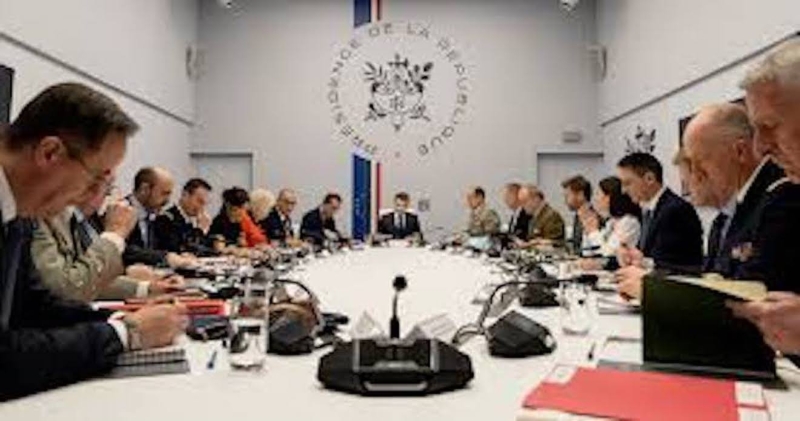
French President Macron Council of Defence
(Source: Elysee, french Presidency)
(Source: Elysee, french Presidency)
At the same time, the French Presidency Elysee communicated that successive Defence and National Security Councils were meeting to adjust France’s posture in response to the US–Israel strikes on Iran and the Iranian counter attacks, insisting that Paris had not taken part in offensive operations against Iran. The message to both domestic and international audiences was that France was reinforcing its deterrence and protection measures without formally entering the war as a belligerent. (Source US Embassy in UAE, French Presidency, Public Senate TV)
DEFENSIVE POSTURE, TREATY OBLIGATIONS AND THE RISK OF SLIDING INTO WAR
Behind the legal vocabulary of “defensive posture” lies a more uncomfortable strategic reality. France maintains defence agreements and basing arrangements across the Gulf, including in the UAE and Qatar, which create expectations that it will help protect host countries against major external threats, especially when these are linked to the wider alliance system with the United States and European partners. The attack on the base at Abu Dhabi therefore raises the question of how far Paris can limit its role to air and missile defence, maritime escort and evacuation operations, without being drawn into a broader campaign that looks and feels like a war, even if it remains legally framed as collective self defence. The fact that a fellow EU member state, Cyprus, has already been hit by a drone in the same conflict zone only strengthens the argument in Paris that this is no longer a distant crisis, but one with direct implications for European security and for the credibility of the EU’s mutual defence commitments. (Source French presidency, Elysee)
Behind the legal vocabulary of “defensive posture” lies a more uncomfortable strategic reality. France maintains defence agreements and basing arrangements across the Gulf, including in the UAE and Qatar, which create expectations that it will help protect host countries against major external threats, especially when these are linked to the wider alliance system with the United States and European partners. The attack on the base at Abu Dhabi therefore raises the question of how far Paris can limit its role to air and missile defence, maritime escort and evacuation operations, without being drawn into a broader campaign that looks and feels like a war, even if it remains legally framed as collective self defence. The fact that a fellow EU member state, Cyprus, has already been hit by a drone in the same conflict zone only strengthens the argument in Paris that this is no longer a distant crisis, but one with direct implications for European security and for the credibility of the EU’s mutual defence commitments. (Source French presidency, Elysee)
This is an editorial geopolitical analysis, not an on the ground report, based on official statements and the author’s own experience as a Paris based correspondent watching this crisis unfold almost in real time.
EUROPE’S GATEWAY UNDER FIRE:
FROM ABU DHABI TO CYPRUS, HOW THE IRAN WAR PULLS FRANCE TOWARDS THE FRONTLINE
Long before Iranian drones hit a base hosting French forces in Abu Dhabi, the question of humanitarian corridors was already at the heart of France’s diplomatic narrative. As soon as Russia launched its large scale invasion of Ukraine on 24 February 2022, I was among the first correspondents at the Elysée to ask whether France would try to reclaim its role as a peace maker, after having been at the core of the Normandy format and the now defunct Minsk agreements, and whether it would push for secure humanitarian routes to save the lives of civilians and the severely wounded. It is in that same logic, and with those early questions in mind, that this new war in Iran brings us back to the issue of access: corridors for evacuation, protection of medical teams, and guarantees that relief supplies can reach both military partners and local populations.
FROM ABU DHABI TO CYPRUS, HOW THE IRAN WAR PULLS FRANCE TOWARDS THE FRONTLINE
Long before Iranian drones hit a base hosting French forces in Abu Dhabi, the question of humanitarian corridors was already at the heart of France’s diplomatic narrative. As soon as Russia launched its large scale invasion of Ukraine on 24 February 2022, I was among the first correspondents at the Elysée to ask whether France would try to reclaim its role as a peace maker, after having been at the core of the Normandy format and the now defunct Minsk agreements, and whether it would push for secure humanitarian routes to save the lives of civilians and the severely wounded. It is in that same logic, and with those early questions in mind, that this new war in Iran brings us back to the issue of access: corridors for evacuation, protection of medical teams, and guarantees that relief supplies can reach both military partners and local populations.
Today, as Paris links the deployment of assets like the Charles de Gaulle to a promise of humanitarian access, it is effectively replaying a script first tested in Ukraine, but on a much wider Middle Eastern stage that now stretches from the Gulf to the eastern Mediterranean.
HUMANITARIAN ACCESS AND THE FRENCH TRADITION OF AID
Another dimension of France’s preparation is humanitarian. The intensification of strikes around key straits and maritime chokepoints, including the Strait of Hormuz, threatens not only the security of shipping lanes but also the ability of humanitarian actors to reach populations affected by the conflict. In his address and subsequent briefings, Macron linked military deployments with a commitment to guarantee access for humanitarian assistance, in line with France’s long standing tradition of supporting medical NGOs and emergency responders in war zones. Whether through established organisations like Medecins du Monde (The French Doctors), French backed initiatives often labelled as “French doctors”, or multilateral relief efforts coordinated with the UN and the EU, Paris is signaling that any military engagement will be accompanied by efforts to secure corridors for care, evacuation and essential supplies.
Another dimension of France’s preparation is humanitarian. The intensification of strikes around key straits and maritime chokepoints, including the Strait of Hormuz, threatens not only the security of shipping lanes but also the ability of humanitarian actors to reach populations affected by the conflict. In his address and subsequent briefings, Macron linked military deployments with a commitment to guarantee access for humanitarian assistance, in line with France’s long standing tradition of supporting medical NGOs and emergency responders in war zones. Whether through established organisations like Medecins du Monde (The French Doctors), French backed initiatives often labelled as “French doctors”, or multilateral relief efforts coordinated with the UN and the EU, Paris is signaling that any military engagement will be accompanied by efforts to secure corridors for care, evacuation and essential supplies.
In practice, that could mean using naval assets such as the Charles de Gaulle group not only to deter hostile actors, but also to protect humanitarian shipping and medical evacuation routes across the eastern Mediterranean and the Gulf. (Source Euronews TV)
In the space of a few days, what began as a new round of strikes between the United States, Israel and Iran has turned the French base in Abu Dhabi into a frontline symbol of how closely Europe is now tied to the fate of the Gulf. The SMS alerts sent to French citizens in the UAE, the Emirati embassy’s language about “unprecedented” attacks, and the deployment of the Charles de Gaulle all point in the same direction: France is trying to hold a defensive line while fulfilling its treaty obligations and protecting its nationals. As a correspondent who has watched French diplomacy for years, I can see the familiar reflexes at work, the insistence on international law, the promise of humanitarian access, the refusal to admit that a “defensive” posture may, over time, look indistinguishable from participation in a war. Whether Paris can maintain that distinction as more drones and missiles fly over bases like Camp de la Paix will be one of the key tests of this crisis, for France and for the broader European project it claims to embody in the Middle East.
Liability for this article lies with the author, who also holds the copyright. Editorial content from USPA may be quoted on other websites as long as the quote comprises no more than 5% of the entire text, is marked as such and the source is named (via hyperlink).