
News
Germany Records Coldest Christmas in 15 Years as Unusual Winter Grips Nation
Germany’s Coldest Christmas in 15 Years

Frozen Christmas (Source: Saman Hajibabaei )
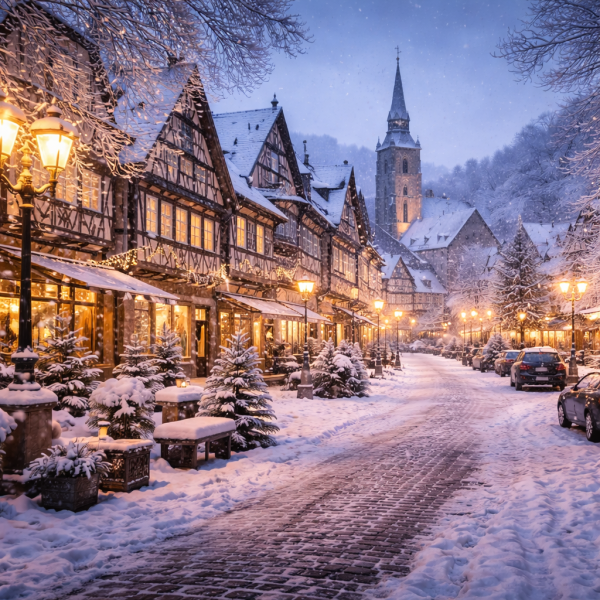
Winter Silence in a German Town
(Source: Saman Hajibabaei )
(Source: Saman Hajibabaei )
In several regions, nighttime temperatures fell sharply below zero. In parts of central and eastern Germany, lows reached approximately minus twelve degrees Celsius, while national averages during the holiday period hovered between minus two and minus three degrees. Meteorologists attribute this event to a stable inflow of cold, dry continental air from Eastern Europe combined with persistent polar air masses, which prevented milder Atlantic systems from reaching the region.
Unlike classic winter disruptions, this cold wave was not primarily driven by heavy snowfall. Snow accumulation remained limited in most areas, but prolonged sub-zero temperatures led to widespread frost, icy road conditions, and frozen infrastructure. As a result, transportation safety became a concern, particularly during nighttime and early morning hours, when black ice significantly increased the risk of traffic accidents and delays in road and rail travel.
The cold spell also placed renewed pressure on Germany’s energy system. Demand for heating rose noticeably, especially in older residential buildings with insufficient insulation. Higher consumption of gas and electricity during an already strained winter energy season has raised concerns among analysts about price stability, supply security, and the resilience of energy networks during extreme weather events.
The cold spell also placed renewed pressure on Germany’s energy system. Demand for heating rose noticeably, especially in older residential buildings with insufficient insulation. Higher consumption of gas and electricity during an already strained winter energy season has raised concerns among analysts about price stability, supply security, and the resilience of energy networks during extreme weather events.
Public health authorities emphasized that such cold conditions pose elevated risks for vulnerable populations, including the elderly, the chronically ill, and people experiencing homelessness. Prolonged exposure to low temperatures increases the likelihood of hypothermia and cold-related illnesses, prompting local governments and aid organizations to expand emergency shelter capacity and outreach services in several cities.
From an international perspective, the German cold snap stands in contrast to milder or even unusually warm Christmas conditions reported in parts of the United States, highlighting the growing unpredictability of global weather systems. For American audiences, this event gains relevance when viewed through the lens of energy security, climate instability, and the human consequences of extreme temperatures across advanced industrial societies.
From an international perspective, the German cold snap stands in contrast to milder or even unusually warm Christmas conditions reported in parts of the United States, highlighting the growing unpredictability of global weather systems. For American audiences, this event gains relevance when viewed through the lens of energy security, climate instability, and the human consequences of extreme temperatures across advanced industrial societies.
Meteorological forecasts suggest that temperatures may gradually moderate in the days following the holiday period, although nighttime frost is expected to persist in many areas. Authorities continue to advise caution in traffic, prudent energy use, and increased attention to at-risk individuals as winter conditions remain volatile.
Germany’s coldest Christmas in over a decade serves as a reminder that extreme weather events are no longer isolated anomalies. Instead, they are increasingly becoming part of a broader pattern of climatic instability with tangible social, economic, and humanitarian implications extending well beyond national borders.
Germany’s coldest Christmas in over a decade serves as a reminder that extreme weather events are no longer isolated anomalies. Instead, they are increasingly becoming part of a broader pattern of climatic instability with tangible social, economic, and humanitarian implications extending well beyond national borders.
more information: https://www.bybobs.de
Liability for this article lies with the author, who also holds the copyright. Editorial content from USPA may be quoted on other websites as long as the quote comprises no more than 5% of the entire text, is marked as such and the source is named (via hyperlink).